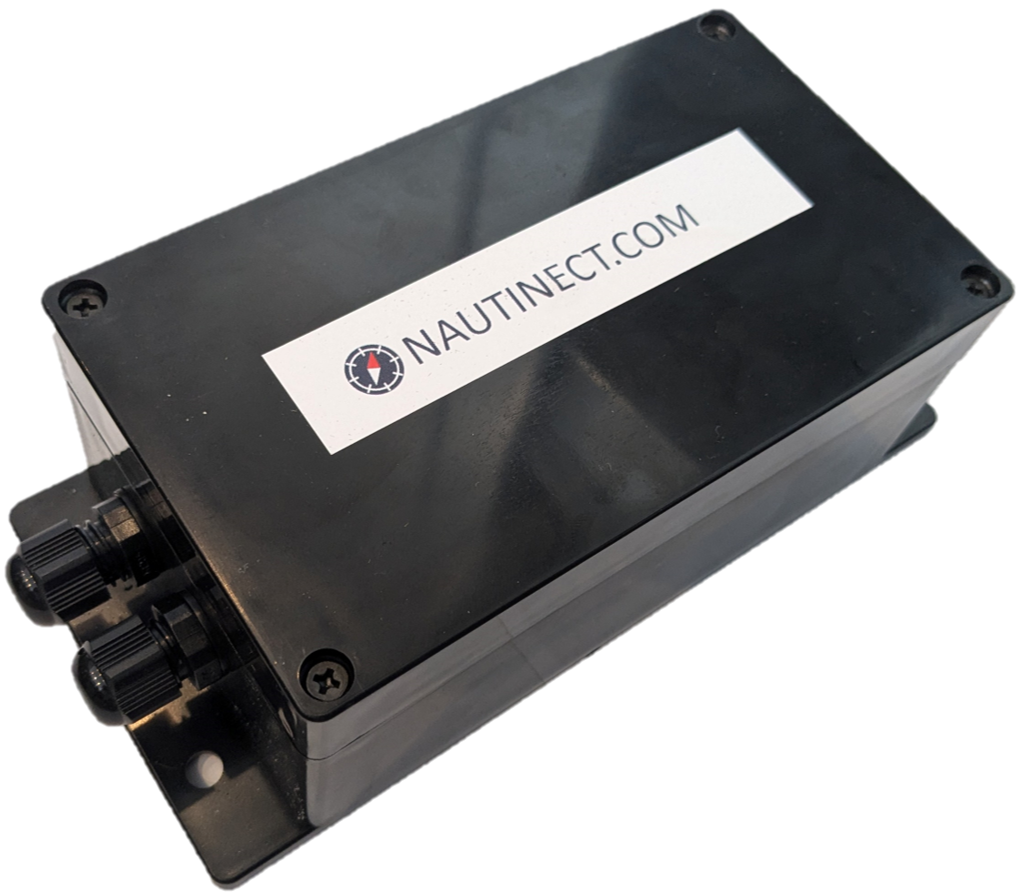
Autopilot Controller v4
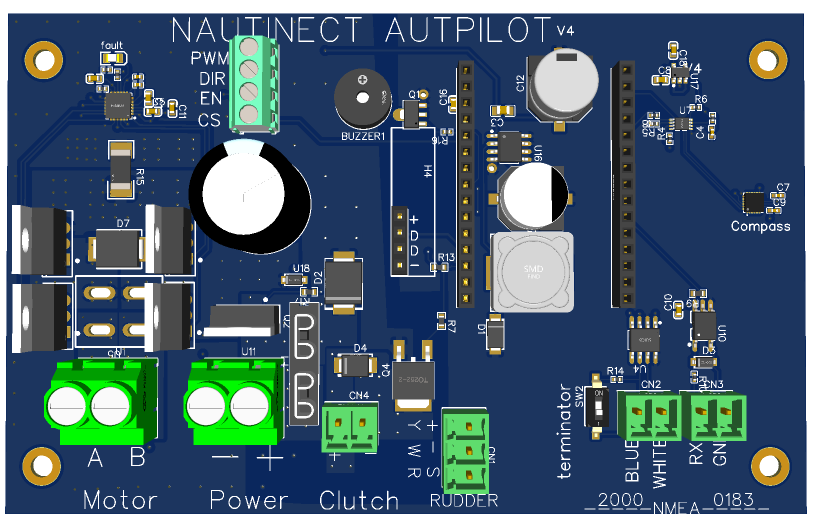
The brains of the autopilot, including the motor controller, are contained in this box. It has everything the autopilot needs: a high-quality 9-degree motion sensor with compass, Wi-Fi, Bluetooth, NMEA input, and a wireless receiver. All you need to do is connect it to your battery and the motor that controls your rudder.
€249.00
1 year warranty
100 days return
*For Non EU countries additional import taxes may applyThis autopilot is very robust and built in a waterproof housing capable of running motors up to 40 Amps at 12 or 24 volts.
- Heading input selection
- Internal compass
- True Wind Angle
- Apparent Wind Angle
- NMEA2000 compass + Rate of Turn*
- NMEA0183 or NMEA2000 GPS*
- Phone Compass
- Phone GPS
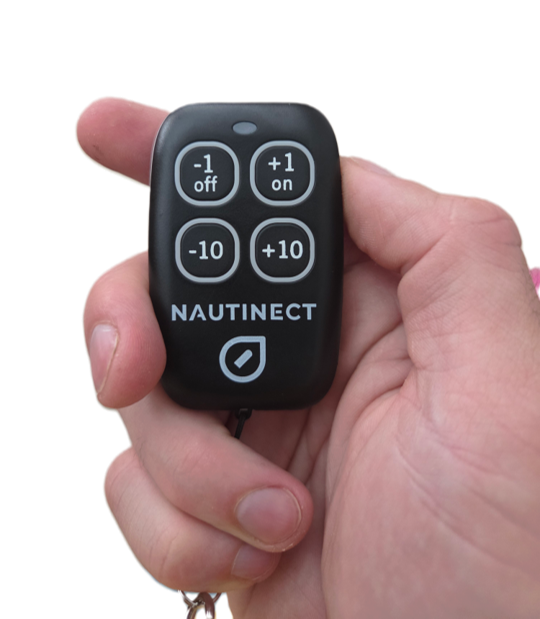
- Wireless remote support (see remote product)
- High precision 9DOF motion chip with compass, accelerometer, and gyroscopes.
- NMEA 0183 support. Wired and via Wi-Fi
- GPS
- Rudder sensor
- NMEA 2000 support
- Compass data as input or output
- Rudder feedback sensor as input or output
- Wind input to steer on wind angles.
- Operation via chartplotter (available in 2026)
- Rudder feedback support for 3-wire resistance-based units like Raymarine
Firmware is updated via your phone app.
The best 9-axis compass available on the market. It features an accelerometer, gyroscope, and magnetic field sensor on 3 axes.
Clutch operation for hydraulic drives and electromagnetic drives (Jeffa & Raymarine)
This unit can operate all existing wheel drives, hydraulic pumps, and under-deck solutions by Raymarine, Navico, Garmin, Autohelm, and others.
Rudder feedback
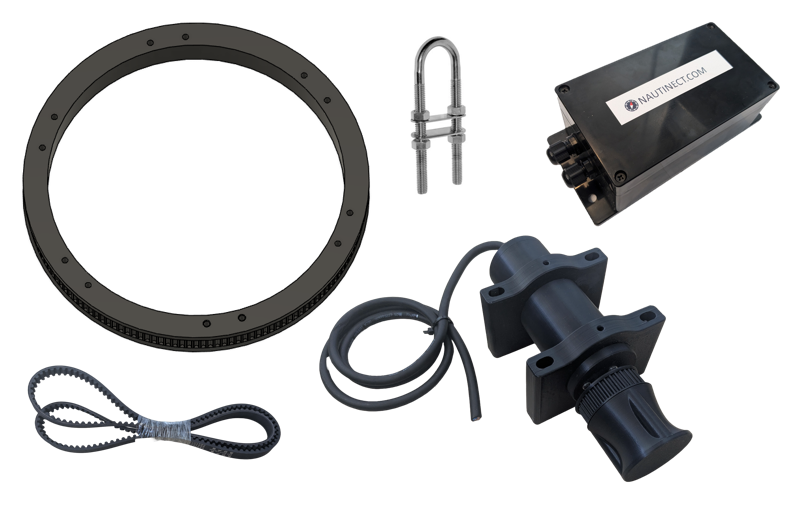
Connecting a Rudder Reference Unit (RFU) greatly improves the behaviour of the autopilot steering. It way more precise with less corrections. This reduces current consumption and wear. A rudder sensor also prevents the motor from running to the end which could potentionally cause damage. Many people use the controller without a rudder sensor which works well on course-steady (bigger) boats. For smaller boats and less-course steady boats I realy recommend a rudder sensor.
Installation
To install the autopilot, you only need to connect 4 wires and place the box with its back against a wall. Wire RED to the battery positive terminal and BLACK to the battery negative terminal. Keep the wires to the motor and battery as short as possible and use cables thick enough to handle the current of your motor. I recommend 4mm² / 12 AWG wires.
The blue and orange cables should be connected to your motor. If more than 2 wires come out of your motor/actuator, the 2 thickest wires are usually directly attached to the motor. Connect those, and test if the rudder moves right when pressing the +1 or +10 button. If the rudder moves the wrong way, simply switch the wires. Alternatively, you can reverse the motor direction in the app.
Box placement
Place the unit with one side pointing upwards, not angled more than 25 degrees. The compass will work in any orientation. Make sure it is not close to metal or wires carrying high current. Place the unit 1 cm away for each Amp that a nearby cable carries. The compass works on steel ships, but does not give an accurate reading because of magnetic field deviation. Since the box is waterproof, it can be mounted on deck, away from metal or wires. Dimensions: 193 × 92 × 64 mm (L × W × H).
You can always contact me or consult the Facebook group.
*Hardware present, software implementation will follow.
Disclaimer
The autopilot is intended as a steering aid, and you should always remain at the helm. The autopilot is not aware of its surroundings and relies on sensitive instruments that may be subject to interference. The seller is not responsible for any damage, loss, or accidents resulting from the use of the autopilot. Use of the autopilot is entirely at the buyer’s own risk. It is the buyer’s responsibility to ensure that the device is suitable and safe for use on their specific boat and in their particular boating conditions.
Actuators
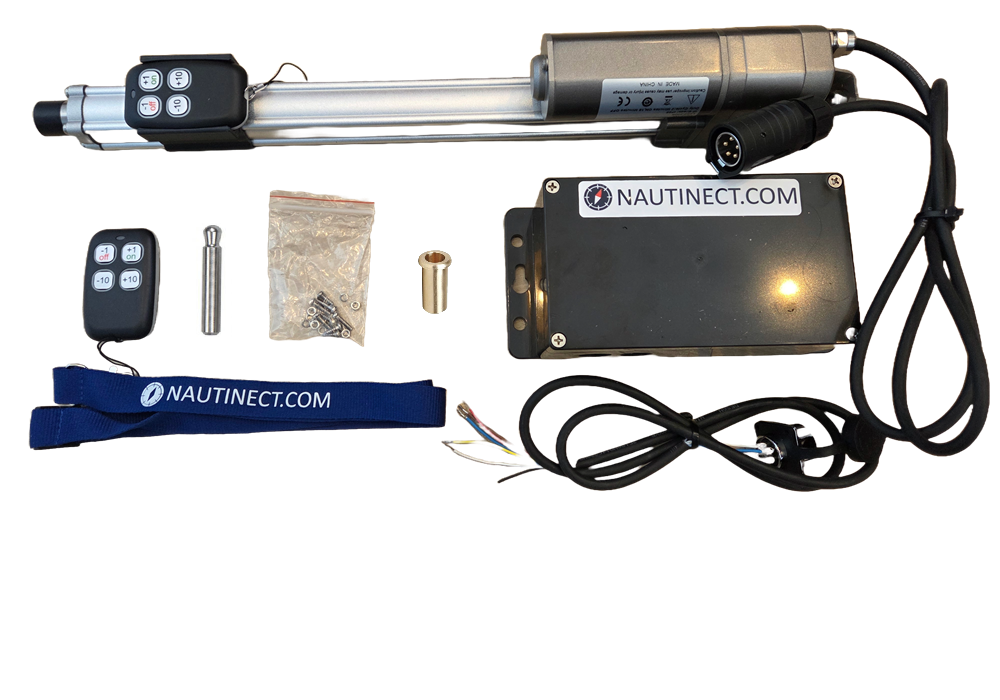
Any brushed DC motor can be used. When buying a linear actuator, one with end-limit switches is advised. If the helm reaches its end and the motor continues to push, this causes heat and can eventually lead to damage. The autopilot on a straight course should not hit the end of the steering. There is built-in protection that ensures the motor does not run for more than 5 seconds at full speed in a single direction to prevent overheating.
Autopilot tuning
Because this autopilot supports a wide variety of motors and types of boats, you need to tune the parameters inside the app.
Files
| File | Type | |
|---|---|---|
| Nautinect autopilot manual.pdf | Manual | Download |
| Nautinect autopilot quick-start.pdf | Manual | Download |
Customer Reviews 4.8/5 (9 reviews)
I installes it on my Dufour sailboat, it works perfectly.
500 sm review - Great autopilot with just one minor tweak needed!
I am overall very happy with this autopilot. The installation was absolute bliss—it's incredibly easy to set up and connects instantly to your mobile device. Being able to operate it via both the wireless remote control and the app makes it super convenient and user-friendly in daily operation. The only downside I’ve encountered so far: even after putting 500 nautical miles on it, I haven't quite managed to find a setting that keeps the steering calm in light winds with a quartering or following sea. In those specific conditions, the autopilot tends to oversteer and makes a lot of unnecessary corrections. However, that is truly the only area that needs some improvement. Other than that, it's an absolutely fantastic product! Highly recommended.
After 15 hours of use, I'm very happy of it: big improvement compared to my previous "classic" autopilot...
I find your autopilot very good; I found the setup quite simple and intuitive. I'm currently building a new mechanism that will allow me to have a disengagement system and relieve some of the load on the tiller. However, I've already connected the autopilot to my old Simrad and after some test sailing, it turns out that the autopilot works very well, even in heavy seas and downwind. I'll send you a link to some sailing footage as an attachment. I'll send you the final result of the system once my project is complete. https://youtube.com/shorts/zeentk1Y7gE?is=bOj7eMt5hWqSNxSf
My experience with the autopilot has been very pleasant. The installation was easy to do. I use the autopilot with a hydraulic steering pump, which worked very well right from the start. Later, I added the rudder sensor, which helps the ship stay on course even better. I made a few adjustments to the settings, such as time integration and the output of the steering pump signal.
started as backup for a H5000 ...:-)
started as a 'backup autopilot' for a fried H5000 set ( which seemed unrepairable for lack of parts??? ) and has now grown to a reliable day to day autopilot ( with some less functionalities but also a lot less clutter and calibration headaches) and still grows. Good support , great value for money ! installation in less than 10 minutes and it was fully functional, so it will stay on board for the rest of it's life! ( which is not a certainty for the B&G H5000 ) I hope Pieter will keep pushing on NMEA2000 functionality and integration?
Very happy with the nautinect autopilot As a solo sailer it's been a game changer
Good autopilot for the money !
Bought the autopilot, installed in an hour or so. After testing i had some issues, but after a short call everything worked superb. Sailed one month with it on my holliday and the autopilot never failed on me.
Amazing product, for or the Everyman sailor, repurposed Raymarine 3000 actuator, just brilliant